NGC 3239 — IB in Leo
IB in Leo, 3.6 arcminutes across, its light 36 million years old. Measured by HyperLEDA, photographed by Pan-STARRS1. Recorded once.
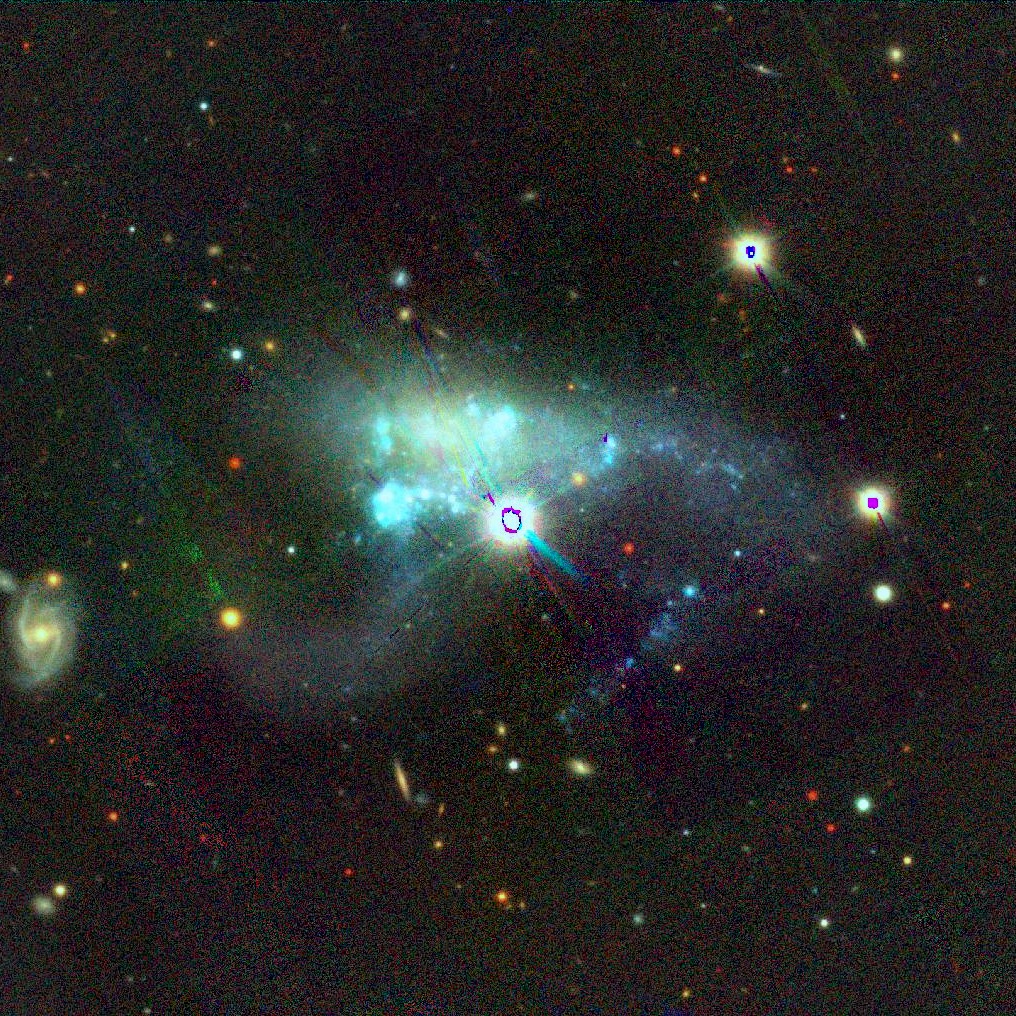
About NGC 3239
What you are looking at
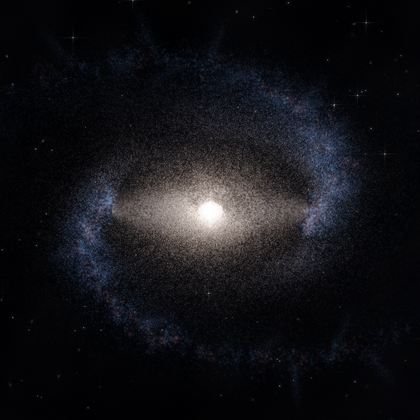
NGC 3239 is an irregular galaxy, with no ordered shape, rich in gas and in young stars. A bar of stars runs straight across its centre, as one does across the centre of the Milky Way. It is tilted about 47° to our line of sight, enough to show both the shape of its arms and the depth of its disc. From edge to edge its visible disc spans about 38,000 light-years (taking its redshift distance, which for a galaxy this near is approximate), about a third the width of the Milky Way.
What astronomers have recorded
Halton Arp included it in his 1966 Atlas of Peculiar Galaxies as Arp 263, a list of galaxies with unusual, disturbed shapes. Boris Vorontsov-Velyaminov listed it as VV 95 in his catalogue of interacting galaxies. One supernova has been recorded in it: SN 2012A. It is cited in 208 scientific papers indexed by SIMBAD, and recorded there under 22 different catalogue designations.
When this light set out
What a telescope records of NGC 3239 is light that left it about 36 million years ago; on Earth, the planet had come through its hottest interval since the dinosaurs. The galaxy is moving away from us at about 752 km/s (1.7 million mph), carried by the expansion of the universe. For a galaxy this close, its own motion through space is a large share of that speed, so the distance worked out from it is approximate; distances measured from individual stars in it can differ.
Finding it in the sky
NGC 3239 lies in Leo. It is best placed on spring evenings: around 9:30 pm in April it stands about 67° high in the south, seen from the middle of the United States.
By apparent size it is number 316 of the 12,657 galaxies on the Galaxy Origins register.
Measurements
| Catalogue | PGC 30560 |
|---|---|
| Morphological type | IB |
| Angular diameter | 3.61′ |
| Right ascension | 10h25m04.9s |
| Declination | +17°09′49.3″ |
| Constellation | Leo |
| Inclination | 46.8° |
| Light travel time | 36 million years |
| Bar | yes, from the catalogue |
Check every figure above in the NASA/IPAC Extragalactic Database
What is sold
A print of this galaxy and the record of the calculation, once. When it sells it leaves the register and is not offered again. We assign no names and no ownership — nobody can sell you those.
At 3.6 arcminutes this is a Exceptional galaxy, which is the tier where a real photograph shows clear structure and dust lanes. The tier comes from the measured diameter, not from a price list.
Take this galaxy — $1,290 Browse the Collection