NGC 4123 — Sc in Virgo
Sc in Virgo, 3.2 arcminutes across, its light 64 million years old. Measured by HyperLEDA, photographed by Pan-STARRS1. Recorded once.
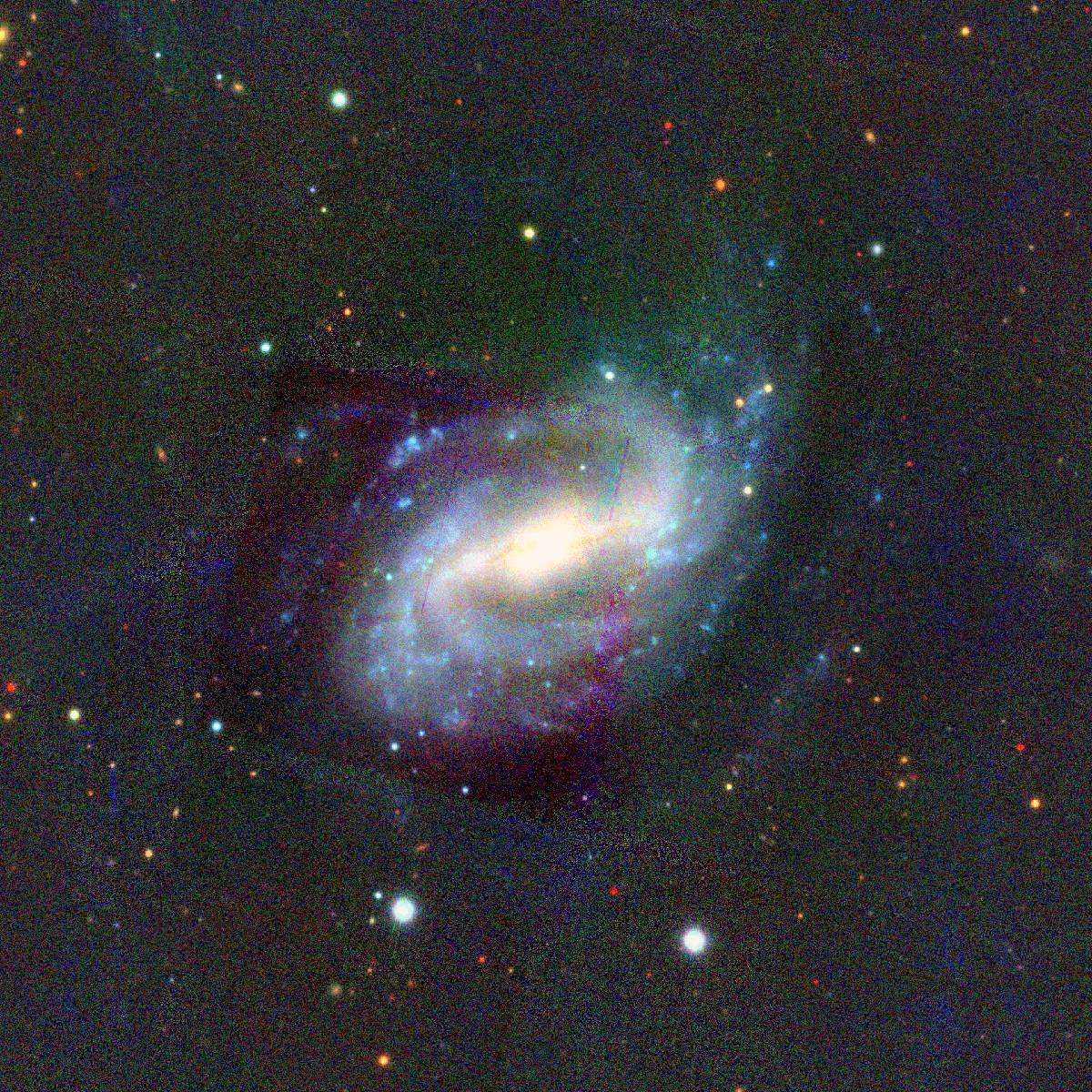
About NGC 4123
What you are looking at
NGC 4123 is a late-type spiral: a small central bulge and open, loosely wound arms full of young stars and star-forming gas. It is tilted about 44° to our line of sight, enough to show both the shape of its arms and the depth of its disc. From edge to edge its visible disc spans about 59,000 light-years (taking its redshift distance, which for a galaxy this near is approximate), about half the width of the Milky Way.
What astronomers have recorded
SIMBAD, the reference database astronomers use, classes it as a galaxy with an active nucleus, powered by its central black hole. Benjamin Markarian listed it as Markarian 1466, among galaxies with unusually strong ultraviolet light. It is cited in 356 scientific papers indexed by SIMBAD, and recorded there under 31 different catalogue designations.
When this light set out
What a telescope records of NGC 4123 is light that left it about 64 million years ago; on Earth, an asteroid had ended the age of dinosaurs. The galaxy is moving away from us at about 1,327 km/s (3.0 million mph), carried by the expansion of the universe. For a galaxy this close, its own motion through space is a large share of that speed, so the distance worked out from it is approximate; distances measured from individual stars in it can differ.
Finding it in the sky
In the sky, NGC 4123 sits within the constellation Virgo. It is best placed on spring evenings: around 9:30 pm in May it stands about 53° high in the south, seen from the middle of the United States.
Its neighbours
At almost the same distance from us, and so its neighbours in space as well as on the sky: NGC 4116 (0.2° away on the sky, at least 260,000 light-years from it); UGC 7178 (1.1° away on the sky, at least 1,260,000 light-years from it); UGC 7035 (1.2° away on the sky, at least 1,280,000 light-years from it); NGC 4179 (2.0° away on the sky, at least 2,180,000 light-years from it).
By apparent size it is number 457 of the 12,657 galaxies on the Galaxy Origins register.
Measurements
| Catalogue | PGC 38531 |
|---|---|
| Morphological type | Sc |
| Angular diameter | 3.18′ |
| Right ascension | 12h08m11.1s |
| Declination | +02°52′41.9″ |
| Constellation | Virgo |
| Inclination | 44.3° |
| Light travel time | 64 million years |
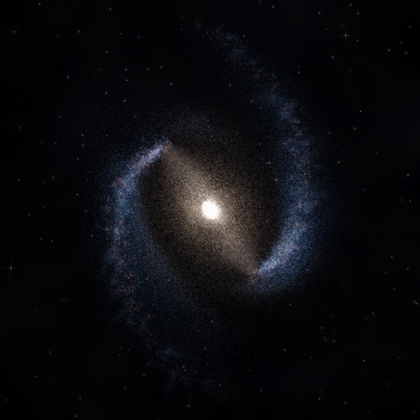
| Bar | yes, from the catalogue |
Check every figure above in the NASA/IPAC Extragalactic Database
What is sold
A print of this galaxy and the record of the calculation, once. When it sells it leaves the register and is not offered again. We assign no names and no ownership — nobody can sell you those.
At 3.2 arcminutes this is a Exceptional galaxy, which is the tier where a real photograph shows clear structure and dust lanes. The tier comes from the measured diameter, not from a price list.
Take this galaxy — $1,290 Browse the Collection