NGC 4302 — Sc in Coma Berenices
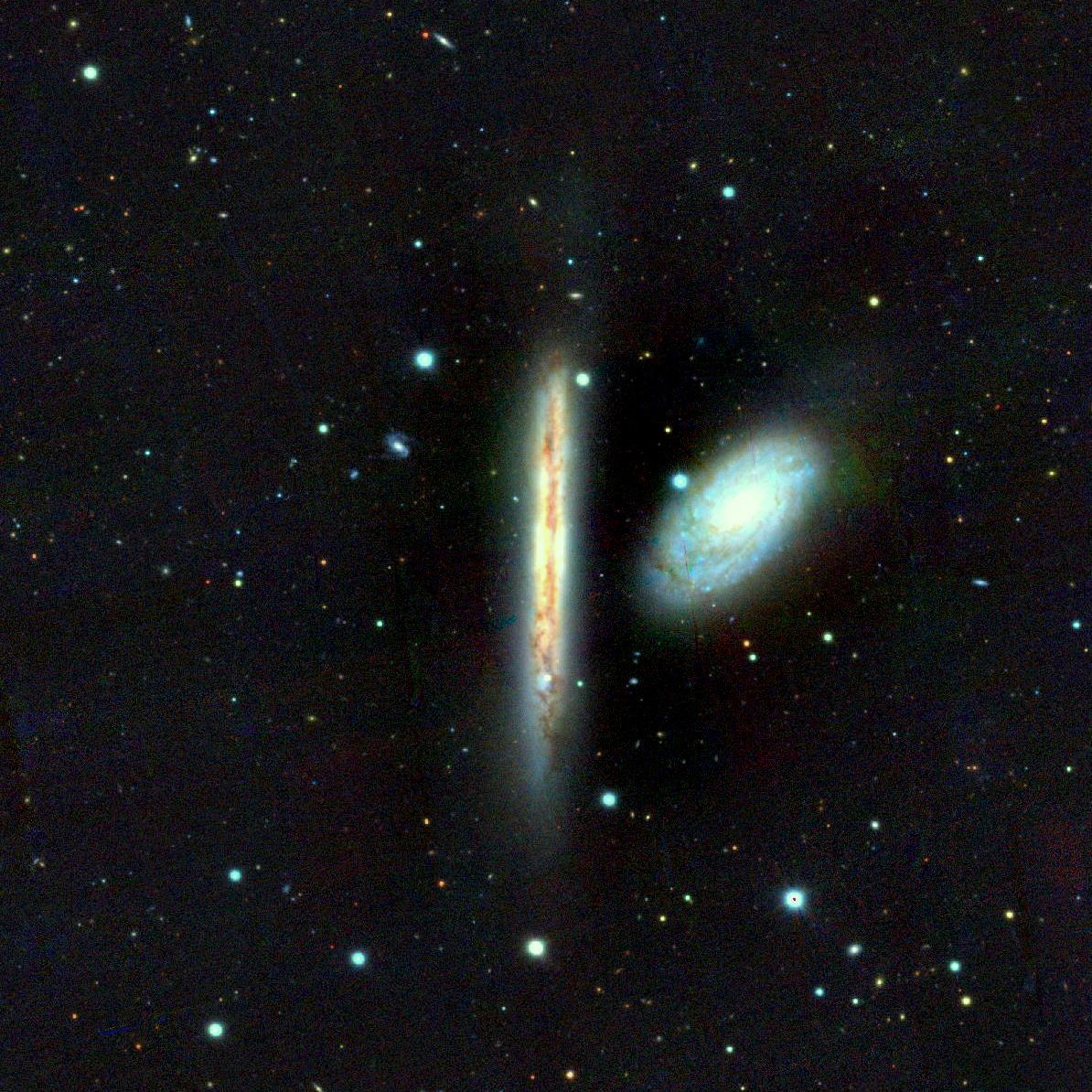
Sc in Coma Berenices, 6.0 arcminutes across, its light 54 million years old. Measured by HyperLEDA, photographed by Pan-STARRS1. Recorded once.
About NGC 4302
NGC 4302 is an edge-on spiral in the Virgo Cluster that forms a striking pair with the face-on NGC 4298 next to it. Hubble imaged the two together in 2017.
What you are looking at
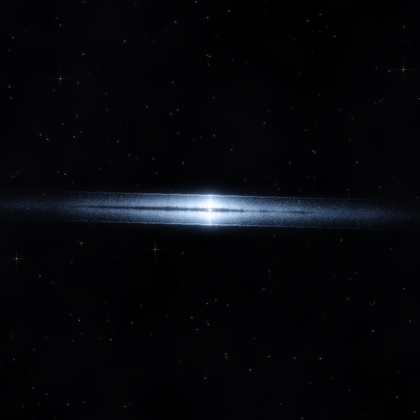
NGC 4302 is a late-type spiral: a small central bulge and open, loosely wound arms full of young stars and star-forming gas. We see it almost exactly edge-on, so its whole disc appears as one thin band of light, with dust showing as a dark line along its length. From edge to edge its visible disc spans about 95,000 light-years (taking its redshift distance, which for a galaxy this near is approximate), close to the width of the Milky Way.
What astronomers have recorded
SIMBAD, the reference database astronomers use, classes it as a member of a cluster of galaxies. One supernova has been recorded in it: SN 1986E. It is cited in 353 scientific papers indexed by SIMBAD, and recorded there under 24 different catalogue designations.
When this light set out
What a telescope records of NGC 4302 is light that left it about 54 million years ago; on Earth, the planet had come through its hottest interval since the dinosaurs. The galaxy is moving away from us at about 1,130 km/s (2.5 million mph), carried by the expansion of the universe. For a galaxy this close, its own motion through space is a large share of that speed, so the distance worked out from it is approximate; distances measured from individual stars in it can differ.
Finding it in the sky
NGC 4302 lies in Coma Berenices. It is best placed on spring evenings: around 9:30 pm in May it stands about 65° high in the south, seen from the middle of the United States.
Its neighbours
It lies in the direction of the Virgo Cluster and at a matching speed, which places it among the cluster’s more than a thousand galaxies, the nearest large cluster to the Milky Way. At almost the same distance from us, and so its neighbours in space as well as on the sky: NGC 4298 (2′ away on the sky, at least 40,000 light-years from it); UGC 7436 (0.2° away on the sky, at least 210,000 light-years from it); NGC 4262 (0.6° away on the sky, at least 570,000 light-years from it); NGC 4377 (0.9° away on the sky, at least 820,000 light-years from it), and 21 more.
By apparent size it is number 80 of the 12,657 galaxies on the Galaxy Origins register.
Measurements
| Catalogue | PGC 39974 |
|---|---|
| Morphological type | Sc |
| Angular diameter | 6.00′ |
| Right ascension | 12h21m42.4s |
| Declination | +14°35′54.4″ |
| Constellation | Coma Berenices |
| Inclination | 90.0° |
| Light travel time | 54 million years |
| Bar | not recorded |
Check every figure above in the NASA/IPAC Extragalactic Database
What is sold
A print of this galaxy and the record of the calculation, once. When it sells it leaves the register and is not offered again. We assign no names and no ownership — nobody can sell you those.
At 6.0 arcminutes this is a Exceptional galaxy, which is the tier where a real photograph shows clear structure and dust lanes. The tier comes from the measured diameter, not from a price list.
Take this galaxy — $1,290 Browse the Collection