M88 (NGC 4501) — Sb in Coma Berenices
Sb in Coma Berenices, 8.7 arcminutes across, its light 109 million years old. Measured by HyperLEDA, photographed by Pan-STARRS1. Recorded once.
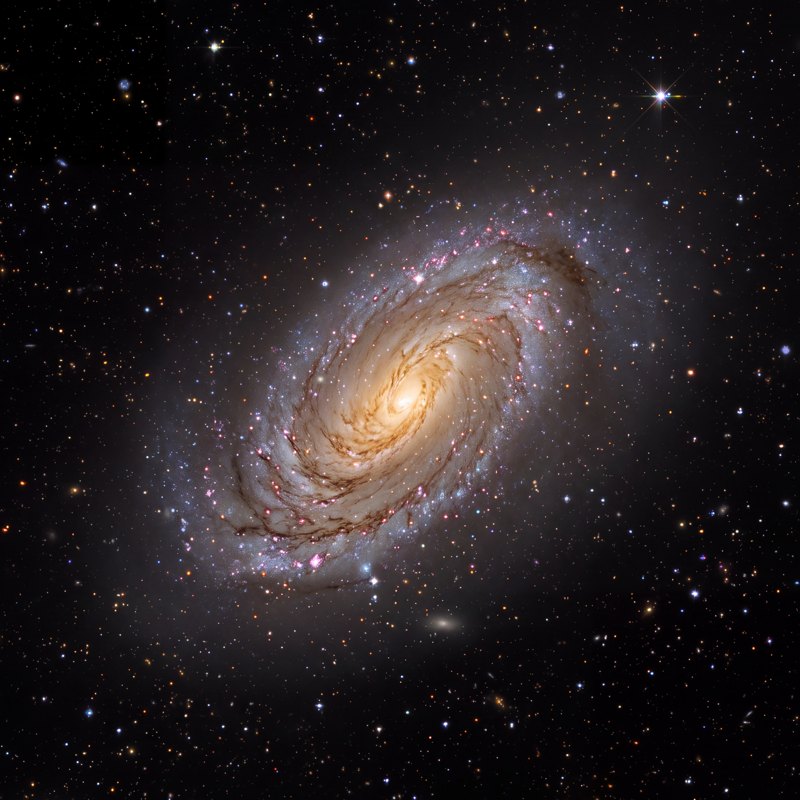
About M88 (NGC 4501)
Messier 88 is one of the brightest spirals in the Virgo Cluster, the great cluster of more than a thousand galaxies that dominates the spring sky. Its arms are long and regularly drawn, and it moves through the cluster quickly, so astronomers watch it for signs of the gas being stripped from its disc.
What you are looking at
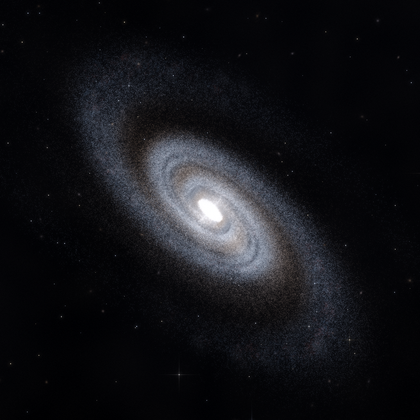
M88 is a spiral with a sizeable central bulge and well-defined arms, close in type to the Milky Way. Its disc is steeply tilted, about 63° from face-on, so it appears as a long oval. From edge to edge its visible disc spans about 274,000 light-years, about 2.8 times the width of the Milky Way.
What astronomers have recorded
SIMBAD, the reference database astronomers use, classes it as a Seyfert galaxy: its nucleus is lit by gas falling into its central black hole, though dust hides part of that glow from us. One supernova has been recorded in it: SN 1999cl. It is cited in 851 scientific papers indexed by SIMBAD, and recorded there under 47 different catalogue designations.
When this light set out
The light that reaches us from M88 today set out about 109 million years ago, when the first flowering plants had appeared. The galaxy is moving away from us at about 2,282 km/s (5.1 million mph), carried by the expansion of the universe.
Finding it in the sky
In the sky, M88 sits within the constellation Coma Berenices. It is best placed on spring evenings: around 9:30 pm in May it stands about 64° high in the south, seen from the middle of the United States.
Its neighbours
It lies in the direction of the Virgo Cluster and at a matching speed, which places it among the cluster’s more than a thousand galaxies, the nearest large cluster to the Milky Way. At almost the same distance from us, and so its neighbours in space as well as on the sky: IC 797 (0.7° away on the sky, at least 1,340,000 light-years from it); IC 800 (1.0° away on the sky, at least 1,990,000 light-years from it); NGC 4476 (2.1° away on the sky, at least 4,050,000 light-years from it); NGC 4388 (2.3° away on the sky, at least 4,410,000 light-years from it), and 2 more.
By apparent size it is number 23 of the 12,657 galaxies on the Galaxy Origins register.
Measurements
| Catalogue | PGC 41517 |
|---|---|
| Morphological type | Sb |
| Angular diameter | 8.65′ |
| Right ascension | 12h31m59.3s |
| Declination | +14°25′12.1″ |
| Constellation | Coma Berenices |
| Inclination | 63.0° |
| Light travel time | 109 million years |
| Bar | not recorded |
Check every figure above in the NASA/IPAC Extragalactic Database
What is sold
A print of this galaxy and the record of the calculation, once. When it sells it leaves the register and is not offered again. We assign no names and no ownership — nobody can sell you those.
At 8.7 arcminutes this is a Exceptional galaxy, which is the tier where a real photograph shows clear structure and dust lanes. The tier comes from the measured diameter, not from a price list.
Take this galaxy — $1,290 Browse the Collection