Whale Galaxy (NGC 4631) — SBcd in Canes Venatici
The Whale Galaxy (NGC 4631) as a framed fine art print. SBcd in Canes Venatici, 14.5 arcminutes across, its light 30 million years old. Measured by…
About Whale Galaxy (NGC 4631)
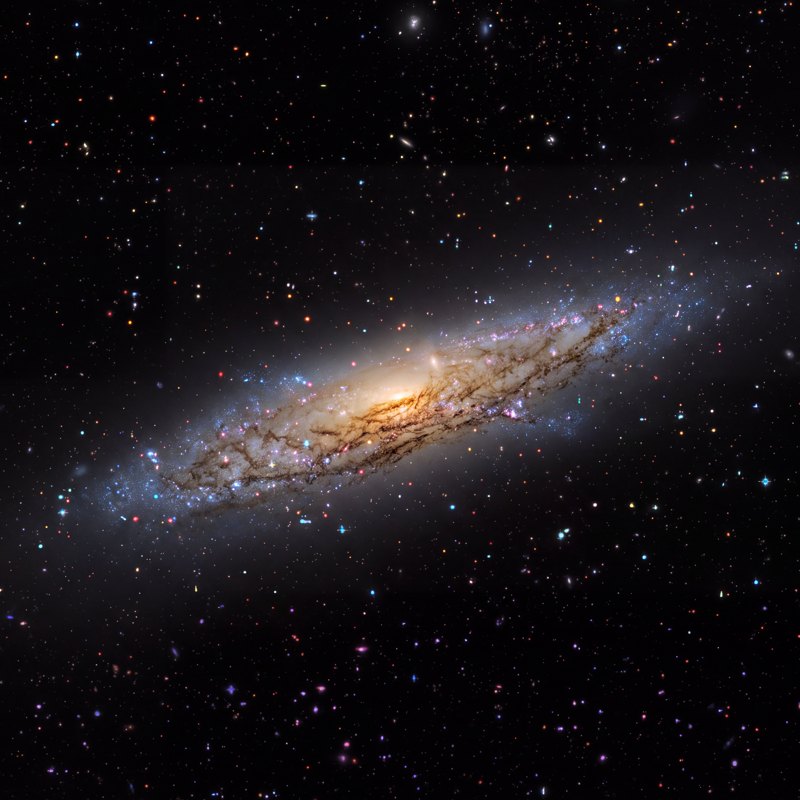
The Whale Galaxy takes its name from its shape: a long edge-on disc, thicker at one end, that looks remarkably like a whale or a herring. It is bursting with new stars, and the heat from that activity has blown a vast halo of hot gas above and below its disc. It is tidally entangled with a small companion, NGC 4627, and with the bent Hockey Stick Galaxy, NGC 4656, which lies close by in the same telescope field.
What you are looking at
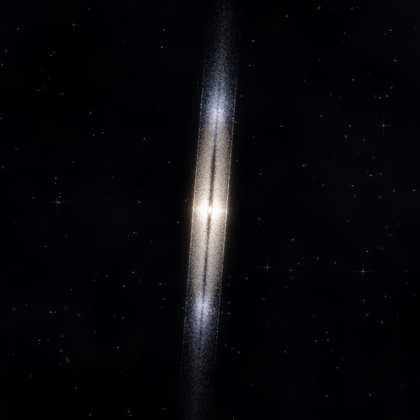
The Whale Galaxy is a late-type spiral: a small central bulge and open, loosely wound arms full of young stars and star-forming gas. A bar of stars runs straight across its centre, as one does across the centre of the Milky Way. Its disc is turned almost exactly side-on to us: the galaxy appears as a narrow blade of light, and its dust as a dark seam running along it. From edge to edge its visible disc spans about 124,000 light-years (taking its redshift distance, which for a galaxy this near is approximate), about 1.3 times the width of the Milky Way.
What astronomers have recorded
SIMBAD, the reference database astronomers use, classes it as a member of a cluster of galaxies. Patrick Moore listed it as Caldwell 32 in his 1995 catalogue of the finest deep-sky objects for amateur observers. Halton Arp included it in his 1966 Atlas of Peculiar Galaxies as Arp 281, a list of galaxies with unusual, disturbed shapes. It is cited in 1,166 scientific papers indexed by SIMBAD, and recorded there under 45 different catalogue designations.
When this light set out
Its light has been travelling for about 30 million years. When it left, Antarctica had begun to freeze. The galaxy is moving away from us at about 616 km/s (1.4 million mph), carried by the expansion of the universe. For a galaxy this close, its own motion through space is a large share of that speed, so the distance worked out from it is approximate; distances measured from individual stars in it can differ.
Finding it in the sky
In the sky, the Whale Galaxy sits within the constellation Canes Venatici. It is best placed on spring evenings: around 9:30 pm in May it stands about 83° high in the south, seen from the middle of the United States.
Its neighbours
At almost the same distance from us, and so its neighbours in space as well as on the sky: NGC 4656 (0.5° away on the sky, at least 280,000 light-years from it); UGC 7916 (1.9° away on the sky, at least 980,000 light-years from it); UGC 7698 (2.2° away on the sky, at least 1,130,000 light-years from it).
By apparent size it is number 4 of the 12,657 galaxies on the Galaxy Origins register.
Measurements
| Catalogue | PGC 42637 |
|---|---|
| Morphological type | SBcd |
| Angular diameter | 14.45′ |
| Right ascension | 12h42m07.8s |
| Declination | +32°32′33.1″ |
| Constellation | Canes Venatici |
| Inclination | 90.0° |
| Light travel time | 30 million years |
| Bar | yes, from the catalogue |
Check every figure above in the NASA/IPAC Extragalactic Database
What is sold
A print of this galaxy and the record of the calculation, once. When it sells it leaves the register and is not offered again. We assign no names and no ownership — nobody can sell you those.
At 14.5 arcminutes this is a Exceptional galaxy, which is the tier where a real photograph shows clear structure and dust lanes. The tier comes from the measured diameter, not from a price list.
Take this galaxy — $1,290 Browse the Collection