NGC 5427 — SABc in Virgo
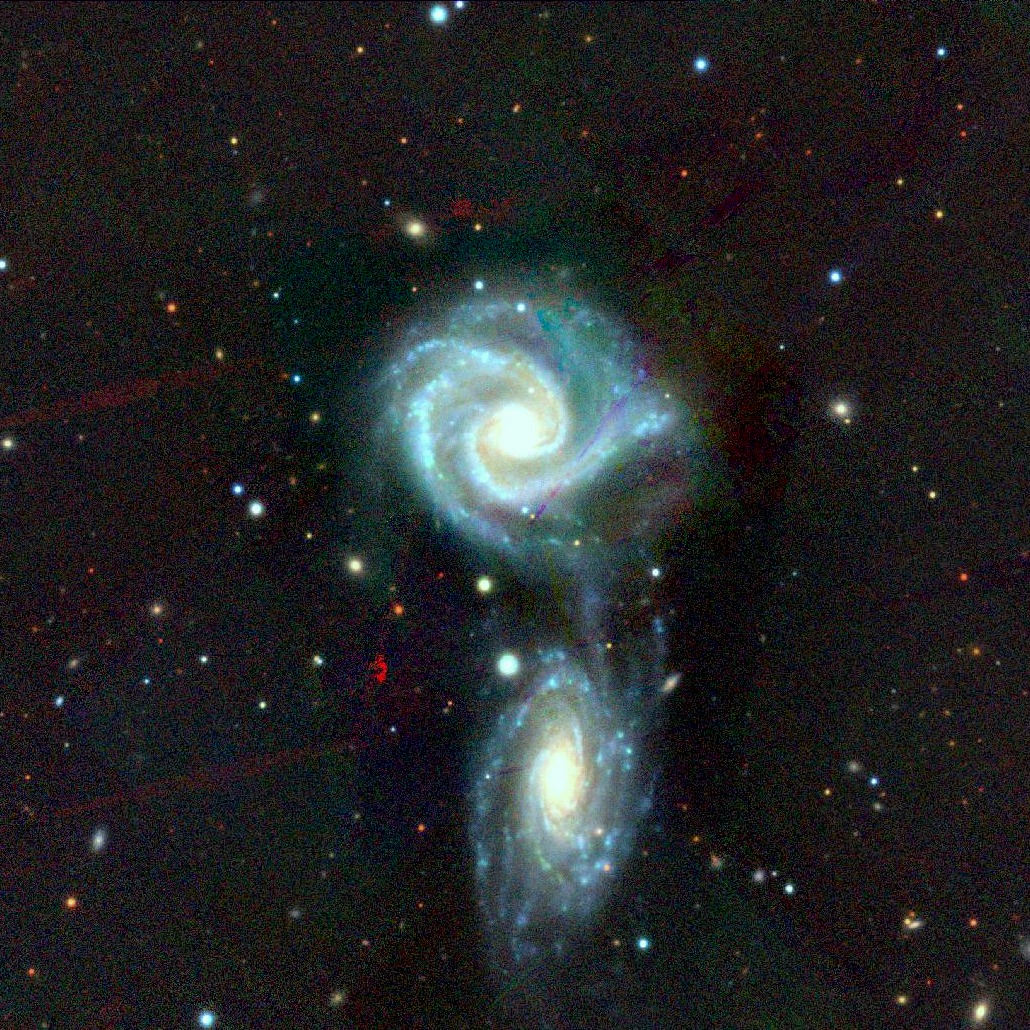
SABc in Virgo, 3.6 arcminutes across, its light 129 million years old. Measured by HyperLEDA, photographed by Pan-STARRS1. Recorded once.
About NGC 5427
NGC 5427 is one of a pair, together catalogued as Arp 271, with NGC 5426. The two spirals are linked by a bridge of gas and stars, and they will merge over the next hundreds of millions of years.
What you are looking at
NGC 5427 is a late-type spiral: a small central bulge and open, loosely wound arms full of young stars and star-forming gas. A weak bar of stars crosses its centre. We look down on it almost face-on, so its structure is laid out as if on a map. From edge to edge its visible disc spans about 134,000 light-years, about 1.4 times the width of the Milky Way.
What astronomers have recorded
SIMBAD, the reference database astronomers use, classes it as a Seyfert galaxy: its nucleus shines brightly with the light of gas falling into its central black hole. Boris Vorontsov-Velyaminov listed it as VV 21 in his catalogue of interacting galaxies. Two supernovae have been recorded in it, the first in 1976; the most recent include SN 1976D, SN 2021pfs. It is cited in 309 scientific papers indexed by SIMBAD, and recorded there under 22 different catalogue designations.
When this light set out
What a telescope records of NGC 5427 is light that left it about 129 million years ago; on Earth, the first flowering plants had appeared. The galaxy is moving away from us at about 2,689 km/s (6.0 million mph), carried by the expansion of the universe.
Finding it in the sky
NGC 5427 lies in Virgo. It is best placed on spring evenings: around 9:30 pm in May it stands about 44° high in the south, seen from the middle of the United States.
Its neighbours
At almost the same distance from us, and so its neighbours in space as well as on the sky: NGC 5426 (2′ away on the sky, at least 90,000 light-years from it); NGC 5468 (1.0° away on the sky, at least 2,180,000 light-years from it); NGC 5472 (1.0° away on the sky, at least 2,320,000 light-years from it); NGC 5476 (1.2° away on the sky, at least 2,620,000 light-years from it), and 1 more.
By apparent size it is number 319 of the 12,657 galaxies on the Galaxy Origins register.
Measurements
| Catalogue | PGC 50084 |
|---|---|
| Morphological type | SABc |
| Angular diameter | 3.61′ |
| Right ascension | 14h03m26.1s |
| Declination | -06°01′50.3″ |
| Constellation | Virgo |
| Inclination | 24.1° |
| Light travel time | 129 million years |
| Bar | yes, from the catalogue |
Check every figure above in the NASA/IPAC Extragalactic Database
What is sold
A print of this galaxy and the record of the calculation, once. When it sells it leaves the register and is not offered again. We assign no names and no ownership — nobody can sell you those.
At 3.6 arcminutes this is a Exceptional galaxy, which is the tier where a real photograph shows clear structure and dust lanes. The tier comes from the measured diameter, not from a price list.
Take this galaxy — $1,290 Browse the Collection