Splinter Galaxy (NGC 5907) — SABc in Draco
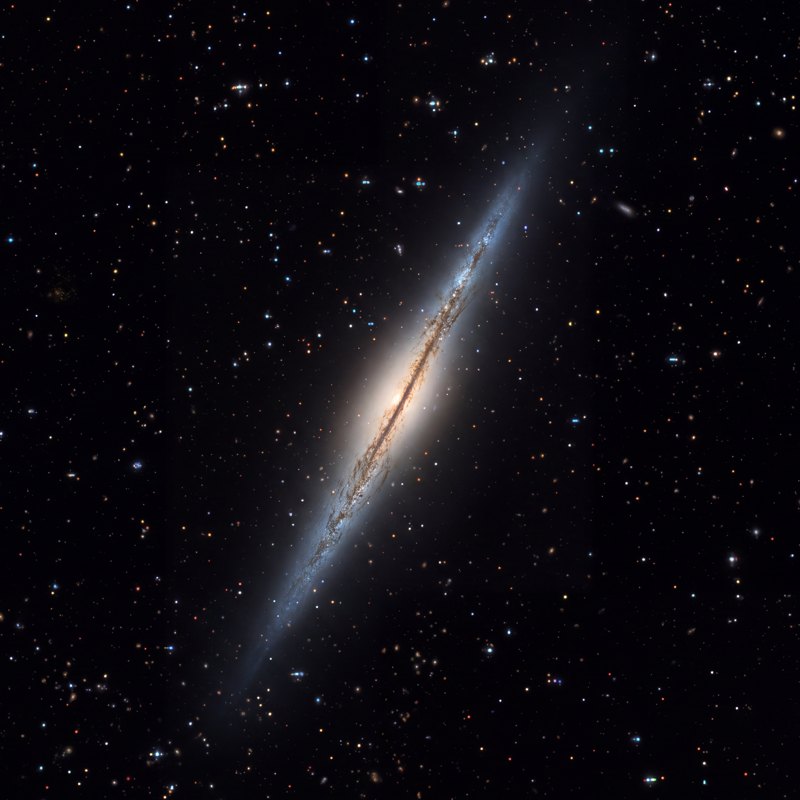
The Splinter Galaxy (NGC 5907) as a framed fine art print. SABc in Draco, 11.3 arcminutes across, its light 32 million years old. Measured by HyperLEDA…
About Splinter Galaxy (NGC 5907)
The Splinter Galaxy is one of the thinnest-looking galaxies in the sky: a spiral seen edge-on, drawn out into a long, narrow streak of light. Very deep images have shown a huge, faint loop of stars around it, the stretched-out remains of a dwarf galaxy torn apart by its gravity, which made NGC 5907 an important case in the study of how galaxies grow by absorbing smaller ones.
What you are looking at
The Splinter Galaxy is a late-type spiral: a small central bulge and open, loosely wound arms full of young stars and star-forming gas. A weak bar of stars crosses its centre. We see it almost exactly edge-on, so its whole disc appears as one thin band of light, with dust showing as a dark line along its length. From edge to edge its visible disc spans about 105,000 light-years (taking its redshift distance, which for a galaxy this near is approximate), close to the width of the Milky Way.
What astronomers have recorded
SIMBAD, the reference database astronomers use, classes it as a member of a group of galaxies. It is cited in 821 scientific papers indexed by SIMBAD, and recorded there under 26 different catalogue designations.
When this light set out
What a telescope records of the Splinter Galaxy is light that left it about 32 million years ago; on Earth, Antarctica had begun to freeze. The galaxy is moving away from us at about 667 km/s (1.5 million mph), carried by the expansion of the universe. For a galaxy this close, its own motion through space is a large share of that speed, so the distance worked out from it is approximate; distances measured from individual stars in it can differ.
Finding it in the sky
The Splinter Galaxy lies in Draco. From most of the United States it never sets: it circles the north celestial pole all year, and stands highest on summer evenings, around June.
Its neighbours
At almost the same distance from us, and so its neighbours in space as well as on the sky: NGC 5866B (0.8° away on the sky, at least 420,000 light-years from it); NGC 5879 (1.1° away on the sky, at least 600,000 light-years from it); NGC 5866 (1.4° away on the sky, at least 800,000 light-years from it); NGC 5870 (1.6° away on the sky, at least 870,000 light-years from it), and 1 more.
By apparent size it is number 10 of the 12,657 galaxies on the Galaxy Origins register.
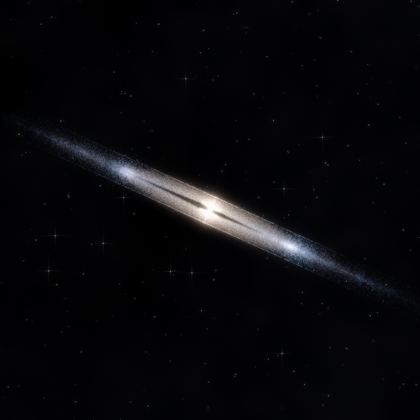
Measurements
| Catalogue | PGC 54470 |
|---|---|
| Morphological type | SABc |
| Angular diameter | 11.30′ |
| Right ascension | 15h15m53.6s |
| Declination | +56°19′44.9″ |
| Constellation | Draco |
| Inclination | 90.0° |
| Light travel time | 32 million years |
| Bar | yes, from the catalogue |
Check every figure above in the NASA/IPAC Extragalactic Database
What is sold
A print of this galaxy and the record of the calculation, once. When it sells it leaves the register and is not offered again. We assign no names and no ownership — nobody can sell you those.
At 11.3 arcminutes this is a Exceptional galaxy, which is the tier where a real photograph shows clear structure and dust lanes. The tier comes from the measured diameter, not from a price list.
Take this galaxy — $1,290 Browse the Collection