NGC 7479 — SBbc in Pegasus
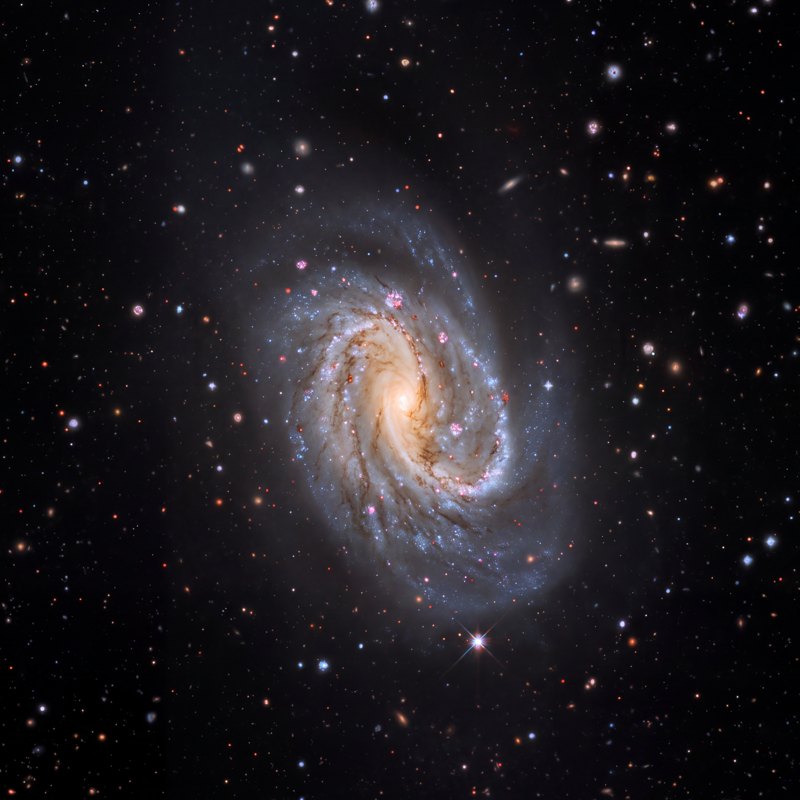
SBbc in Pegasus, 3.6 arcminutes across, its light 114 million years old. Measured by HyperLEDA, photographed by Pan-STARRS1. Recorded once.
About NGC 7479
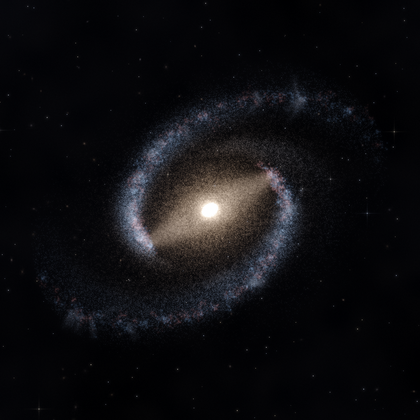
NGC 7479 is a barred spiral with a strong, straight bar and arms that curl in opposite directions. Radio images show a jet from its centre that winds the opposite way to its visible arms, a sign that it has merged with a smaller galaxy.
What you are looking at
NGC 7479 is a spiral of the same broad class astronomers give the Milky Way: a moderate bulge and clearly drawn arms. A bar of stars runs straight across its centre, as one does across the centre of the Milky Way. It is tilted about 43° to our line of sight, enough to show both the shape of its arms and the depth of its disc. From edge to edge its visible disc spans about 121,000 light-years, about 1.2 times the width of the Milky Way.
What astronomers have recorded
SIMBAD, the reference database astronomers use, classes it as a Seyfert galaxy: its nucleus is lit by gas falling into its central black hole, though dust hides part of that glow from us. Patrick Moore listed it as Caldwell 44 in his 1995 catalogue of the finest deep-sky objects for amateur observers. Two supernovae have been recorded in it, the first in 1990; the most recent include SN 1990U, SN 2009jf. It is cited in 789 scientific papers indexed by SIMBAD, and recorded there under 43 different catalogue designations.
When this light set out
The light that reaches us from NGC 7479 today set out about 114 million years ago, when the first flowering plants had appeared. The galaxy is moving away from us at about 2,380 km/s (5.3 million mph), carried by the expansion of the universe.
Finding it in the sky
In the sky, NGC 7479 sits within the constellation Pegasus. It is best placed on autumn evenings: around 9:30 pm in October it stands about 62° high in the south, seen from the middle of the United States.
Its neighbours
At almost the same distance from us, and so its neighbours in space as well as on the sky: UGC 12300 (1.2° away on the sky, at least 2,280,000 light-years from it); UGC 12281 (1.9° away on the sky, at least 3,760,000 light-years from it); UGC 12308 (2.2° away on the sky, at least 4,370,000 light-years from it); NGC 7437 (2.6° away on the sky, at least 5,120,000 light-years from it).
By apparent size it is number 301 of the 12,657 galaxies on the Galaxy Origins register.
Measurements
| Catalogue | PGC 70419 |
|---|---|
| Morphological type | SBbc |
| Angular diameter | 3.65′ |
| Right ascension | 23h04m56.7s |
| Declination | +12°19′22.1″ |
| Constellation | Pegasus |
| Inclination | 43.0° |
| Light travel time | 114 million years |
| Bar | yes, from the catalogue |
Check every figure above in the NASA/IPAC Extragalactic Database
What is sold
A print of this galaxy and the record of the calculation, once. When it sells it leaves the register and is not offered again. We assign no names and no ownership — nobody can sell you those.
At 3.6 arcminutes this is a Exceptional galaxy, which is the tier where a real photograph shows clear structure and dust lanes. The tier comes from the measured diameter, not from a price list.
Take this galaxy — $1,290 Browse the Collection